Tools for people who write from sources.
Zero History publishes free, open-source software for historians, analysts, journalists and anyone writing a book or a long piece from evidence. Our flagship is Anabasis: drafts, notes, sources, citations and a research journal in one file that runs offline in your browser. Beside it is a kit for open-source research: citations, timelines, dashboards and maps that carry their sources.
Free and open source. No account and no tracking. Your work stays on your computer.
Ask Socrates
One of the tools inside Anabasis. Try it here.
Every part of Anabasis, struck as a coin. Pick one to watch it work.
Gather
Keep every book, article and web page you use in one library. Paste a DOI, ISBN or link and the details fill themselves in; search it and open any source to see its record. Read a PDF with a note pad beside it, the page filled in for every note.
Anabasis 2.12, out now
A desk arranged the way you work
The first week of public use brought a list, and 2.12 answers it: themes, including your own colors; any part full screen with another beside it; task lists for a chapter or a single section; drafting colors and code snippets; sketches drawn with Excalidraw; and the index cards you wrote by hand, brought in as notes.
Also in 2.12
- Socrates, more carefulQuestions fit your words: “Are the Ten Thousand…”, “an FBI file”.
- The Oracle, more like a personA pause, an “I see”, and it comes back to what you said earlier. Still no AI.
- Readable in every themeEvery theme, highlight and drafting color is checked for contrast on every build.
- Sealed sketchesExcalidraw runs in a sandbox with no way into your project, and drawings are cleaned before they open.
- Tested at scale300,000 words, 1,500 sources and 780 task lists open in seconds and type without stalls.
- Code that stays codeSnippets kept exactly as typed, fixed-width, never run, fenced in Markdown.
Showcase
Everything else it does, in motion
Every part of Anabasis that came before 2.12, from the literature grid and Socrates to the book for print and the Quartermaster, filmed in the real app with a sample project. Choose a kind of work, then a tool.
Open the research guide in the journal to see what each stage of a project is for, what to do, and how to tell when it’s done. Tick through checklists for sources, quotes and numbers, ethics and consent, and the last pass before you submit; read a short guide to your method; look up a term in the glossary.
Anabasis, a writing desk for nonfiction
Named for Xenophon’s march to the sea. It formats citations as you write, checks the draft the way a careful editor would, and keeps you company when you’re working alone.
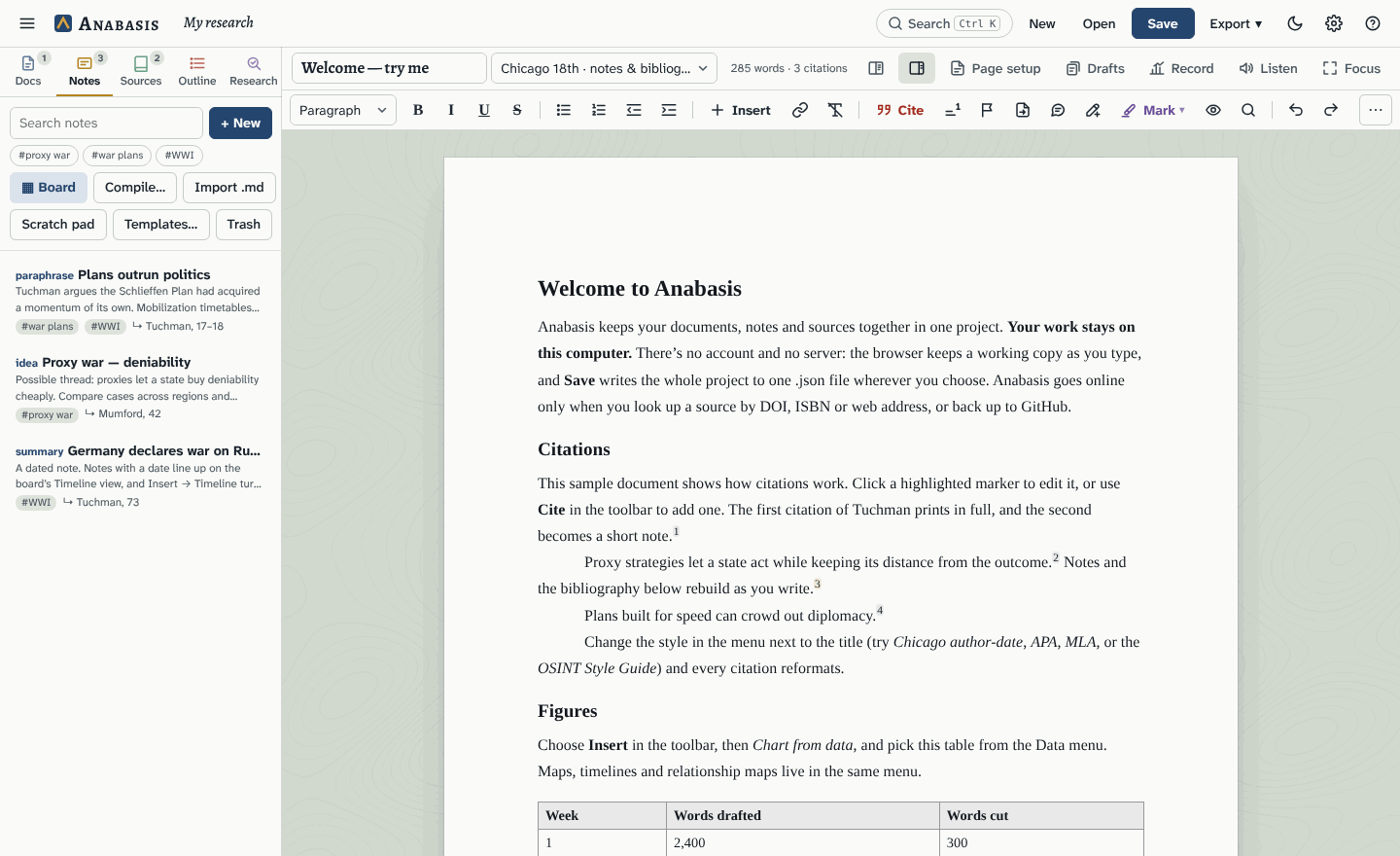
New in 2.12
Themes and your own colors, workspaces with any part full screen, task lists for every chapter and section, Excalidraw sketches, and the index cards you wrote by hand, brought in as notes.
See what’s newThe Oracle
Think out loud and it asks the next question, the way ELIZA did at MIT in the 1960s. No AI, nothing online: it answers from your own notes, notices when you’re tired or going in circles, and picks up where you left off.
Beside the writingSocrates
Not sure what to ask? 475 questions in 24 kinds, from evidence and causation to ethics and intelligence analysis, fitted to whatever you’ve selected. He reads your draft for the places that need one, and walks you through five methods, from steelmanning to competing explanations.
Try it aboveYour work, for good
One file you keep, an archive of plain Markdown and BibTeX, and a format that won’t break. Co-write by passing a copy back and forth, no server needed.
How it’s keptFree, and open
Every tool is free and its code is public under an open-source license. Read it, build it yourself, check every download against its published checksum.
Yours alone
No accounts and no servers. Your writing stays on your computer, and our tools go online only when you ask them to look something up.
Built to last
Plain, documented files you can open without us, decades from now. Nothing has zero history, including your notes.
More tools from Zero History
Four tools for open-source research built on one citation form, and a builder for the eBooks, white papers and briefs that come out of it.
Write to us
Questions, bug reports, ideas for a tool, and press requests come straight to us.
Nothing has zero history.